COLOUR/BOUNDARY Gallery North Newcastle University UK (group)2014


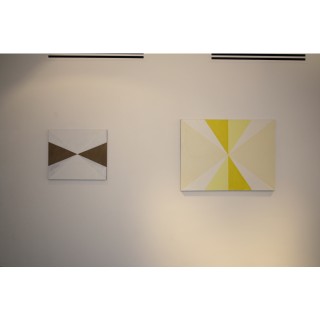
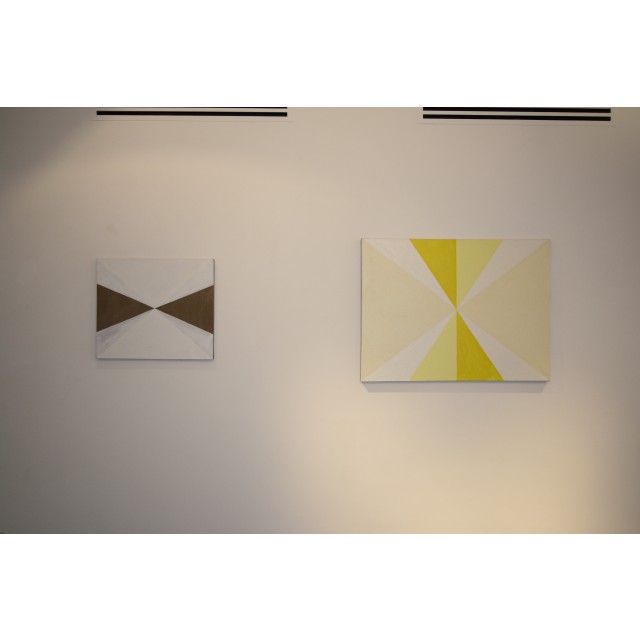


Excerpt from Colour Boundary catalogue essay
[..]Colour and decoration have always been able to form a comfortable alliance of mutual dependency. A two-dimensional structure can be designed and filled with any combination of hues whose chromatic relationships may be striking, discordant or harmonious. The pattern into which the colour fits will have its own visual characteristics. It may be florid or reserved, busy or minimalist, or anywhere in between. It can also be figurative or abstract, and as pattern is most often applied to a surface, the similarities with painting are inevitable. And painting hasn ’ t tried to avoid the comparison. It has employed stripes and grids, which are devices it shares with the visual language of pattern, and simplified objects into flat shapes before formally re- organising them to suit its own compositional purposes, which is a practice appropriated from the activities of the designer. The distinction between pattern and painting is not glaringly obvious. I would say that it rests on the fact that the relationships between elements within a painting are ‘ pictorial’ rather than ‘decorative ’ . This comparison often leads to a debate about the relative cultural value of the ‘decorative arts ’ , however, it might be more interesting to consider how the idea of ‘ pictorial relationships ’ can be interpreted in the context of the present discussion. When I talk about the separable fields of vision and sound in cinema, or the territorial outline and codified colour in topography, I suggest they give rise to a certain solidity or density of experience, yet they do not necessarily open onto the same reality. Inboth cases two worlds are in play. T ranslated into pictorial art these are the worlds of painting and the colour world. Painters, working on a blank plane, have to produce aworld. They do not have to reproduce one, as mirrors and cameras are compelled toby their physics. The world produced by the first painters that we know of was a worldof animals, a population of bison, antelope, (but not reindeer) scratched into the cavewall. That was their terrain. Matisse’s equivalent world comprises flattened rooms and tipped up tablecloths to which he super-adds a second world of full and active colour.The paintings in this exhibition display a similar structure. Each painter has created an invented terrain, of geometry, both loose and tight, of complex interlocking shapes, ofa woven space of gestural movement and stasis. On this world they have mapped another in which colour relationships become visible within chosen boundaries: The division of the monochrome, the contrasting material spectrum of earths and artificial pigments, the heraldic palette and the optical tingle of the worked surface, the push and pull of background and foreground, the border between the tonal and the chromatic.[..]
David Sweet
2014